Today I was having coffee with my friend Carmen, who’s 54 and recently retired from teaching. She pulled out her phone and showed me an article about the food pyramid 2026 changes that had her completely rattled. “Susana,” she said, her voice tight with frustration, “I’ve spent thirty years following this thing. I ate my whole grains, avoided fat, counted calories. And now they’re telling me it was wrong all along?” Her hands were shaking as she stirred her cortado. I looked at her face and saw something I’ve seen so many times in women our age: anger mixed with relief. Anger at the wasted years, relief that maybe it wasn’t our fault after all.
But here’s what really struck me as I started researching this topic: not all food pyramids are created equal. And depending on which country’s guidelines you’ve been following, you might have been set up to fail — or given a surprisingly solid foundation.
Let me show you what I mean.
Three Pyramids, Three Very Different Messages
I’ve been looking at three major food guidelines: the new American “Real Food” pyramid, the UK’s Eatwell Guide, and Spain’s Pirámide NAOS. And honestly? The differences are shocking.
The UK Eatwell Guide: A Disaster in Disguise
Let’s start with the UK’s official guidance, because it perfectly represents everything that went wrong with nutritional advice for the past 40 years.
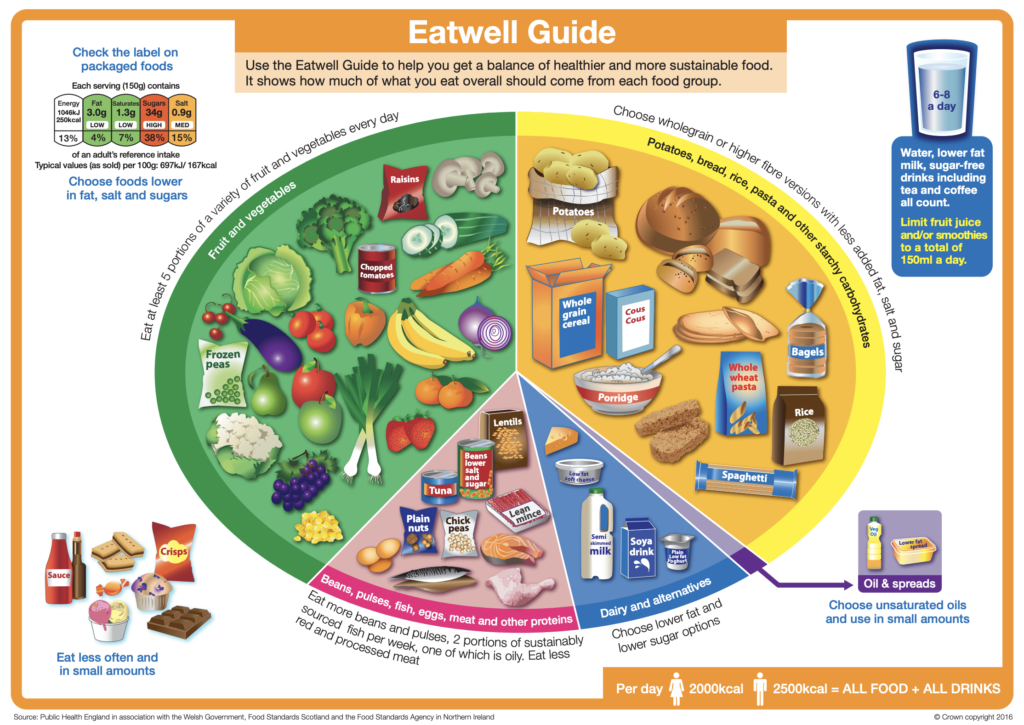
Look at that plate. What dominates? Starchy carbohydrates — potatoes, bread, rice, pasta, cereals — taking up a massive chunk of what you’re supposed to eat. The guide literally says “choose wholegrain or higher fibre versions with less added fat, salt and sugars.”
But here’s what kills me: in the corner, there’s a tiny section for oils and spreads with the instruction to “choose unsaturated oils and use in small amounts.” Small amounts! Meanwhile, you’re supposed to fill up on bagels, rice, and spaghetti.
And the protein section? “Eat more beans and pulses, 2 portions of sustainably sourced fish per week, one of which is oily. Eat less red and processed meat.” Two portions of fish per week. That’s it.
The drinks recommendation? “Water, lower fat milk, sugar-free drinks including tea and coffee all count.” Lower fat milk. In 2016 (when this was published) we were still being told to avoid fat.
Someone in my Facebook group posted last week: “So you’re telling me that eating a tablespoon of olive oil is better than eating a fat-free yogurt loaded with sugar? My brain is broken.” I completely understand that feeling. If you’ve been following the Eatwell Guide, your brain should be broken — because the guidance itself is.
What’s glaringly missing from the UK guide? Any mention of water intake. Any mention of physical activity. It’s purely about what goes on your plate, with no acknowledgment that health is about more than just food portions.
Spain’s Pirámide NAOS: They Got Two Things Right
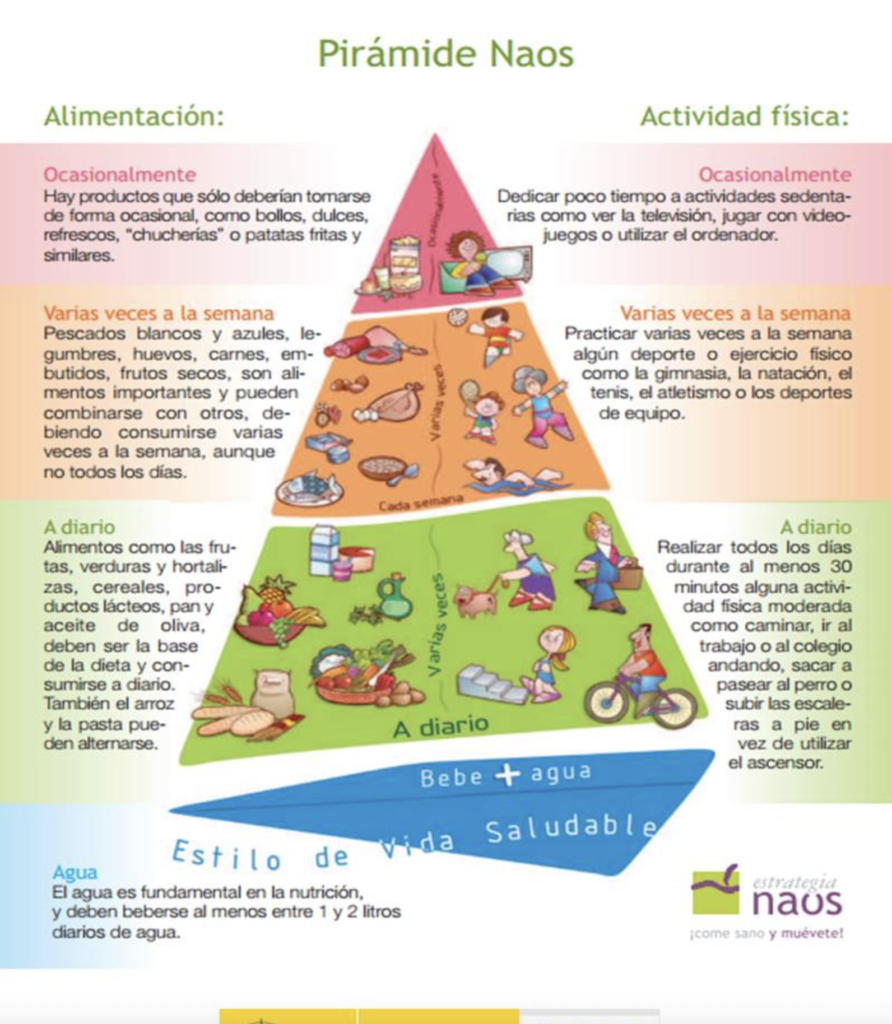
Now look at Spain’s approach. Yes, the base still includes cereals, bread, pasta, and rice alongside fruits, vegetables, dairy, and olive oil for daily consumption. Not perfect by keto standards, I know.
But here’s what Spain understood that the UK completely missed:
Water as the foundation. At the very bottom of the Spanish pyramid, before anything else: “Bebe + agua” — drink more water. The guide recommends 1-2 liters daily. Water is fundamental to nutrition, they say. It’s not an afterthought tucked into a corner. It’s literally the base of the entire pyramid.
Movement is built into the guidance. The Spanish pyramid has two columns: Alimentación (food) on the left, and Actividad física (physical activity) on the right. Every level of the food pyramid has a corresponding activity level:
- Daily foods = Daily movement (30 minutes of moderate activity like walking, cycling, taking stairs)
- Weekly proteins = Weekly sports (swimming, tennis, team sports several times per week)
- Occasional treats = Limited sedentary time (less TV, video games, computer time)
This isn’t a food pyramid. It’s a lifestyle pyramid. And that’s a crucial difference.
My neighbor Rosa is 68 and has the energy of someone decades younger. I’ve watched how she eats, yes — olive oil on everything, fatty fish twice a week, loads of vegetables. But I’ve also watched how she lives. She walks to the market daily. She takes the stairs. She’s never belonged to a gym, but she moves constantly. The Spanish pyramid understands that you can’t separate food from movement.
The New American “Real Food” Pyramid: Finally, Some Sense
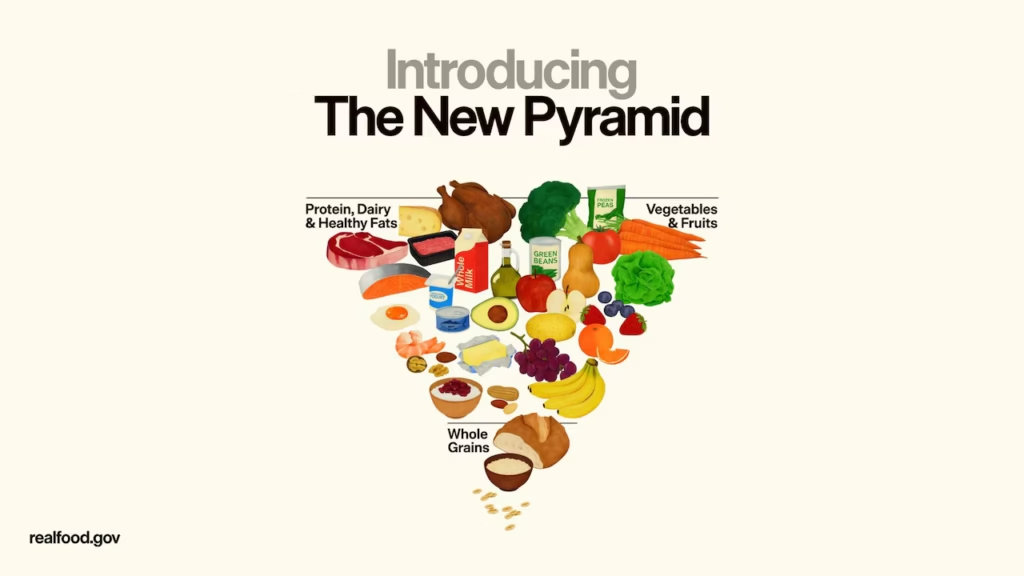
The 2026 U.S. guidelines are finally catching up to what Mediterranean cultures have practiced for centuries. Protein and healthy fats at the base. Vegetables and fruits in the middle. Grains — limited to 2-4 servings — pushed to the top.
This is revolutionary for America, where the old pyramid had us eating 6-11 servings of grains daily while treating fat like poison.
But what excites me most is the core message: “Eat Real Food.” Food your grandmother would recognize. Food that doesn’t need a nutrition label because it IS the nutrition.
Why This Matters More After 40
Here’s what no one talks about enough: most food pyramids were created based primarily on studies of young men. Not women. Definitely not women in their 40s and 50s dealing with declining estrogen and progesterone.
When I was 39 and still 100kg, I was eating exactly what the UK Eatwell Guide told me to eat. Lots of whole grains, minimal fat, plenty of skim milk. I was hungry all the time, exhausted by 2pm, and gaining weight despite “doing everything right.”
After 40, our bodies process food completely differently. Our insulin sensitivity changes. Our ability to build muscle shifts. Our metabolism slows. Following guidelines designed for 25-year-old men — or worse, guidelines that ignore the role of movement entirely — isn’t just ineffective. It can actively work against our changing hormones.
I had a client, let’s call her Lucia, who’s 48 and works in finance in Madrid. She came to me after her doctor told her to eat more whole grains to lose weight. “I’m eating oatmeal for breakfast, brown rice with lunch, whole wheat pasta for dinner,” she told me. “And I’ve gained five kilos in six months.” The frustration in her voice was palpable.
The Mediterranean Advantage We’ve Been Sitting On
Living in Spain has taught me something the Americans are finally catching up to: traditional Mediterranean eating — combined with an active lifestyle — has been doing this right all along.
A 2023 study published in the Journal of Women’s Health followed 800 perimenopausal women and found that those eating a Mediterranean-style diet with higher fat content AND maintaining regular physical activity had fewer hot flashes, better sleep quality, and more stable weight compared to those following traditional low-fat guidelines with sedentary lifestyles.
It’s not just about what you eat. It’s about how you live.
When Carmen asked me what she should do differently, I didn’t just tell her to add olive oil to her vegetables. I told her to walk to the shops instead of driving. To take the stairs when she could. To stop sitting for hours watching TV in the evening.
She called me three weeks later. “Susana, I have energy at 3pm. I haven’t had energy at 3pm in five years. Is this what normal people feel like?”
What I Wish I’d Known at 39
If I could go back and talk to my younger self, struggling with the scale and convinced I just needed more willpower, I’d tell her three things:
- The UK-style low-fat, grain-heavy approach was wrong. Your body isn’t broken. The guidance was.
- Water matters more than you think. The Spanish got this right. Hydration isn’t an afterthought — it’s foundational.
- Movement isn’t optional. You can’t out-eat a sedentary lifestyle, no matter how “clean” your diet is.
I spent years eating fat-free everything and wondering why I felt terrible. Fat-free cheese that tasted like rubber. Fat-free dressings loaded with sugar. Dry chicken breast because I was terrified of the skin. I was following the rules perfectly and feeling terrible.
And I barely moved. I thought diet was the answer. It’s only part of the answer.
Making Sense of the Changes for Your Real Life
Look, I’m not saying everyone needs to do strict keto like I do. But here’s what I think the evidence clearly shows:
Prioritize protein. The new American guidelines are finally emphasizing protein at every meal, which is essential for maintaining muscle mass as we age. I aim for about 30 grams with each main meal.
Embrace healthy fats. I use olive oil liberally now. I eat the skin on my roasted chicken. I snack on olives and cheese. These fats keep me satisfied for hours and support hormone production in a way that fat-free crackers never did.
Rethink your carb sources. If I’m going to eat carbs, they’re coming from vegetables first, maybe some berries, occasionally some legumes. The days of building meals around bread and pasta are behind me.
Drink water. Not diet soda. Not sugar-free drinks. Water. The Spanish pyramid puts it at the foundation for a reason.
Move daily. Not just three times a week at the gym. Daily movement — walking, stairs, gardening, whatever gets you off the couch. This is non-negotiable.
Marta, my friend who’s 52 and teaches in Barcelona, put it perfectly: “I stopped asking ‘what carb should I pair with this protein’ and started asking ‘what vegetables sound good with this fish, and can I walk to get the ingredients?’ It’s a shift in thinking, but it changed everything.”
The Emotional Side of Dietary Whiplash
I saw a post on Reddit that absolutely broke my heart. A woman wrote: “I’m 47. I’ve been overweight since my 30s despite following every guideline. I exercised. I ate low-fat. I counted points. And now they’re changing the pyramid? I feel like I’ve been lied to my entire adult life.”
I get it. That anger is valid. We were told fat would kill us. That we needed 6-11 servings of grains daily. That calories in, calories out was all that mattered. And for many of us, following those rules led to weight gain, metabolic issues, and years of feeling like failures.
But here’s what I try to remember: science evolves. What matters now is what we do with better information going forward.
Moving Forward Without Regret
I try not to dwell on the years I spent fighting my body with low-fat everything and minimal movement. What’s done is done. But I do feel angry sometimes that better information wasn’t available sooner — and that some countries (looking at you, UK) are still pushing outdated guidance.
What helps is focusing on now. I know better, so I do better. And I try to help other women skip the years of struggle I went through.
The new American food pyramid won’t fix everything. The Spanish approach isn’t perfect either (too many grains at the base for my liking). But both understand something the UK Eatwell Guide completely misses: health isn’t just about portion sizes on a plate. It’s about hydration. It’s about movement. It’s about real food, not processed low-fat alternatives.
If you’re feeling confused or frustrated by the changing advice, you’re not alone. Thousands of us are navigating this together, figuring out what works for our real bodies and real lives.
Trust yourself. Pay attention to how different foods make you feel. Move your body daily. Drink your water. And know that it’s never too late to start treating your body better.