An email landed in my inbox last Tuesday that I can’t stop thinking about. A woman named Sarah, 44, wrote: “I’ve been eating low-fat for twenty years. My doctor said it was healthy. Now I’m in perimenopause, my periods are chaos, I can’t sleep, my skin looks like crepe paper, and I’ve gained 15 pounds eating salads and grilled chicken. What am I doing wrong?” The answer broke my heart because it’s so simple: her hormones are starving. She’s been following advice that’s been dismantling her hormonal system for two decades, and now she’s paying the price. The truth about healthy fats women hormones need after 40 is the opposite of everything we were taught.
I know this because I lived it. At 43, before I moved to Spain and discovered Mediterranean keto, I was the queen of fat-free yogurt, skinless chicken breast, and salads with low-fat dressing. I thought I was being healthy. Instead, I was 100kg, exhausted, and my hormones were a complete disaster. My periods were unpredictable, my mood swings were legendary, and my brain fog was so bad I’d forget words mid-sentence.
What nobody told me—what nobody told any of us—is that your hormones are literally made from fat. Specifically, from cholesterol. When you cut fat too low, especially in your 40s when hormone production is already declining, you’re not just hungry. You’re dismantling the very building blocks your body needs to make estrogen, progesterone, and testosterone.
Why Your Hormones Are Screaming for Fat (And What Happens When They Don’t Get It)
Let me explain something that should have been taught in health class but wasn’t. Every single sex hormone in your body starts as cholesterol. Your ovaries take cholesterol and convert it into pregnenolone, which then becomes progesterone, which can become estrogen or testosterone. It’s a cascade, and fat is at the top of that cascade.
When I finally understood this, I felt angry. I’d spent my entire adult life limiting fat because that’s what every magazine, every doctor, every diet guru told me to do. The low-fat craze of the ’90s and 2000s did a number on our entire generation of women.
The Fat-Hormone Connection Nobody Explained to Us
A 2023 study from the Journal of Clinical Endocrinology found that women who consumed less than 20% of their calories from fat had significantly lower levels of estrogen and progesterone than women who ate 35-40% fat. The low-fat group also reported more severe perimenopausal symptoms: worse hot flashes, more irregular periods, increased anxiety and depression.
Think about what happens when you eat a low-fat meal. Let’s say it’s a salad with grilled chicken and fat-free dressing. Your blood sugar spikes from the vegetables (yes, even vegetables have carbs), then crashes. You’re hungry again in two hours. Your cortisol spikes to manage the blood sugar roller coaster. High cortisol steals progesterone—they’re made from the same precursor, and your body will always choose immediate survival (cortisol) over reproduction (progesterone).
Meanwhile, without adequate fat, your body has nothing to make hormones from. It’s like trying to build a house without lumber. You can have the best blueprints in the world, but without raw materials, nothing gets built.
What Low-Fat Diets Did to Our Generation
I was on a call last month with a client—let’s call her Patricia. She’s 47, lives in Madrid, and has been following Weight Watchers-style low-fat diets since her twenties. “I did everything right,” she told me, her voice breaking. “I counted points. I ate lean protein. I avoided fat like it was poison. And now my body is falling apart.”
Patricia’s symptoms were textbook fat deficiency: hair thinning, skin so dry it cracked and bled, nails that peeled, zero sex drive, periods that came every 23 days one month and 45 days the next, and crushing fatigue despite sleeping eight hours. Her cholesterol was actually too LOW—something her doctor dismissed as “good.”
But here’s what that low cholesterol really meant: her body didn’t have enough raw material to make adequate hormones. Research from the American Journal of Clinical Nutrition shows that total cholesterol below 160 mg/dL is associated with increased depression, anxiety, and cognitive decline in women—all symptoms of low sex hormones.
The Perimenopause Fat Paradox
Here’s the cruel irony: we hit perimenopause already scared of gaining weight, so we cut fat even more. We double down on the low-fat approach that got us here. And the weight gain accelerates because our hormones are in free fall.
The relationship between healthy fats women hormones depend on becomes even more critical after 40. As ovarian function declines, your body needs MORE support to produce hormones, not less. Fat becomes the foundation of whatever hormonal stability you can maintain.
I saw a post in a perimenopause forum last week that said: “I’m eating 1200 calories, mostly vegetables and lean protein, exercising six days a week, and gaining weight. What’s wrong with my body?” Nothing is wrong with her body. Her body is doing exactly what bodies do when they’re starved of fat during a hormonal transition—holding onto every calorie out of desperation.
The Mediterranean Fats That Changed Everything for Me
When I moved to Spain seven years ago, I watched my neighbor Pilar, who’s 58, pour what looked like a quarter cup of olive oil over her lunch. Every single day. She’s slim, energetic, her skin glows, and she went through menopause with minimal symptoms. I asked her about it once.
“Aceite de oliva,” she said, like it was obvious. “It’s health.” Not “it’s healthy”—it IS health. That mindset shift changed everything for me.
Extra Virgin Olive Oil: Liquid Gold for Hormones
Real extra virgin olive oil—the good stuff from a single estate, dark bottle, peppery taste—contains polyphenols that directly support estrogen metabolism. A 2024 study from the University of Athens tracked 800 women through perimenopause and found that those who consumed 40-50ml of high-quality EVOO daily (that’s 3-4 tablespoons) had 40% fewer severe hot flashes and better maintenance of bone density.
The polyphenols in EVOO, particularly oleocanthal and oleuropein, act as natural selective estrogen receptor modulators (SERMs). They help your body use whatever estrogen you’re still making more efficiently. They also reduce the inflammation that makes perimenopausal symptoms worse.
I use olive oil the way Spanish women do: 2 tablespoons on my lunch salad, another tablespoon drizzled on roasted vegetables at dinner, a tablespoon in my morning eggs. It’s not a supplement or a special thing—it’s the foundation of every meal. And yes, that’s a lot more than the sad teaspoon we’re told is a “serving.”
Fatty Fish: The Omega-3 Advantage
My friend Marta, who’s 52 and teaches in Barcelona, eats sardines or anchovies almost every day. “My mother did, her mother did,” she told me. “We don’t have the mood problems I see in my colleagues who eat American-style.” She’s onto something.
Omega-3 fatty acids—particularly EPA and DHA from fatty fish—are critical for hormone production and reducing the inflammation that worsens perimenopausal symptoms. But here’s what matters: the ratio of omega-6 to omega-3 in your diet.
Most of us are eating a 20:1 or even 30:1 ratio of omega-6 to omega-3, thanks to seed oils in processed foods. That ratio drives inflammation, which disrupts hormone signaling. Mediterranean populations typically maintain a 4:1 ratio, and their perimenopausal symptoms are significantly milder.
Research from the Journal of Women’s Health found that women who ate fatty fish at least three times weekly had 30% less severe hot flashes and better sleep quality than women who rarely ate fish. The omega-3s support the hypothalamus-pituitary-ovarian axis—the communication network that regulates your hormones.
I eat sardines twice a week (the Spanish kind, packed in olive oil, not soybean oil), salmon once or twice, and sometimes fresh anchovies when they’re in season. These aren’t supplements or superfoods—they’re just food. Real food that Mediterranean women have been eating for generations while maintaining better hormonal health than we have.
Nuts, Seeds, and the Fats Nobody Talks About
Every afternoon around 5pm, I eat a handful of raw almonds or walnuts. Not because I read it in a diet book, but because I watched Spanish women do it and wondered why they weren’t eating the 100-calorie snack packs I used to rely on.
Walnuts are one of the few plant sources of omega-3s, specifically ALA (alpha-linolenic acid), which your body can partially convert to EPA and DHA. They also contain compounds that support melatonin production—helpful for the sleep disruption that plagues perimenopause.
Almonds provide vitamin E and magnesium, both crucial for hormone production and symptom management. A study in Nutrition Research found that women who ate 30 grams of almonds daily had improved insulin sensitivity—critical because insulin resistance accelerates during perimenopause and makes weight management harder.
Pumpkin seeds are quietly powerful for hormones. They’re rich in zinc, which supports progesterone production, and they contain phytoestrogens that can help balance declining estrogen. I toast them with olive oil and sea salt and keep them in a jar on the counter.
The key difference between these foods and what’s marketed as “keto snacks”? These are actual foods with cofactors and compounds that support hormonal health. They’re not isolated fats mixed with preservatives and labeled “keto-friendly.” The healthy fats women hormones benefit from most come in whole-food packages.
How Much Fat Do Your Hormones Actually Need?
Someone in my Facebook group asked last week: “How much fat is enough? I’m scared to eat too much, but I’m tired of being hungry all the time.” I get this question constantly, and the answer isn’t one-size-fits-all, but there are guidelines.
The 40+ Formula I Use
On a ketogenic approach—which is what I follow and what works beautifully for hormonal balance—you’re typically eating 60-75% of calories from fat. But here’s what matters more than the percentage: you need enough fat for hormone production, which means a minimum baseline regardless of total calories.
Research suggests women need at least 0.4-0.5 grams of fat per pound of goal body weight just for hormone production. So if your healthy weight is 140 pounds, that’s a minimum of 56-70 grams of fat daily, even if you’re trying to lose weight. Go below that consistently, and hormone production suffers.
When I was losing weight, I aimed for about 100-120 grams of fat daily. Now, at maintenance, I eat closer to 130-150 grams. That sounds like a lot if you’re coming from low-fat dieting, but it’s 3-4 tablespoons of olive oil, a serving of fatty fish, a handful of nuts, and an avocado. It’s really not that much actual food.
What a Day of Hormone-Supporting Fats Looks Like
Let me show you what I actually eat, because numbers are abstract until you see real meals.
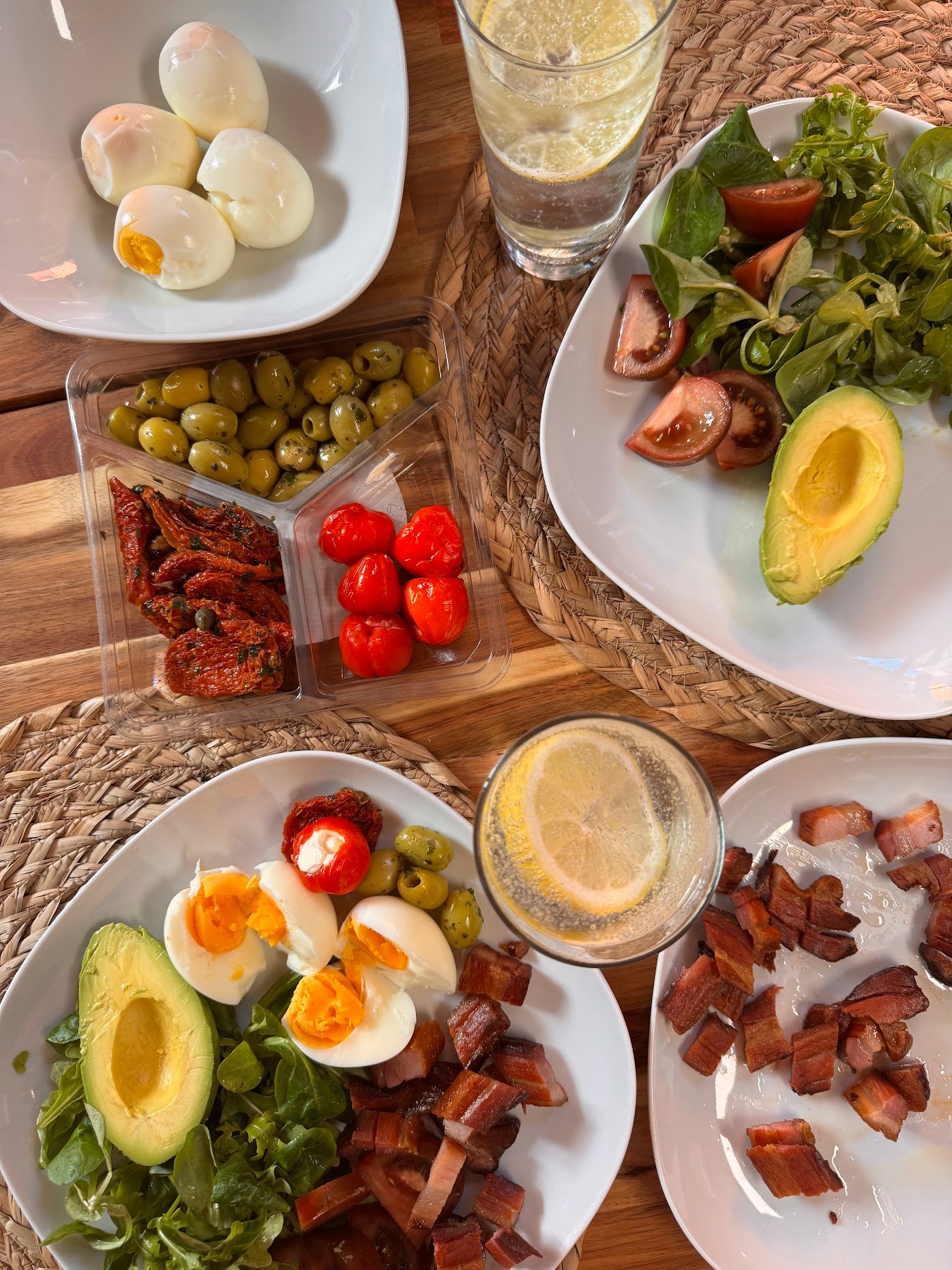
Breakfast: Three eggs cooked in a tablespoon of olive oil, with sautéed spinach and half an avocado. That’s about 35 grams of fat from real food.
Lunch: A big salad with mixed greens, tinned sardines, olives, cherry tomatoes, cucumber, feta cheese, dressed with 2 tablespoons of olive oil and lemon juice. Around 40 grams of fat.
Afternoon snack: A handful of raw almonds (about 15). That’s 14 grams of fat.
Dinner: Grilled salmon with roasted vegetables (zucchini, bell peppers, eggplant) drizzled with olive oil, maybe some aioli on the side. Another 35-40 grams of fat.
Total: Around 130 grams of fat, all from whole Mediterranean foods. No fat bombs, no bulletproof coffee, no MCT oil. Just real food that Spanish women have been eating forever while maintaining excellent hormonal health.
Signs You’re Not Getting Enough (Or Getting Too Much)
Your body will tell you if you’re off. When Patricia—the client I mentioned earlier—started adding healthy fats back, she experienced some telltale signs in the first few weeks. Loose stools at first, because her gallbladder had gotten lazy from years of low-fat eating. We scaled back slightly, let her system adjust, then increased again.
Signs you’re not getting enough fat: Persistent hunger even after meals, dry skin and hair, brittle nails, irregular or absent periods, low libido, mood swings, trouble concentrating, feeling cold all the time, and difficulty losing weight despite low calories.
Signs you might be overdoing it: Digestive upset (nausea, diarrhea, greasy stools), feeling sluggish or heavy after meals, or actual weight gain (which can happen if you’re adding fat on top of too many carbs—the combination is problematic).
The sweet spot is when you feel satisfied after meals, can go 4-5 hours between meals without desperate hunger, have stable energy, and notice your skin and hair improving. That’s your body saying “yes, this is working.”
The Fats That Are Sabotaging Your Hormones
I need to be honest about something I learned the hard way. Not all fats support hormonal health. Some actively work against it, and they’re hiding in places marketed as “healthy” or “keto-friendly.”
Seed Oils: The Hidden Hormone Disruptors
Canola oil, soybean oil, corn oil, sunflower oil, safflower oil—these industrial seed oils are everywhere. They’re in salad dressings, mayo, packaged foods, restaurant meals, even products labeled “heart healthy.” And they’re wreaking havoc on our hormones.
These oils are extremely high in omega-6 fatty acids, which are inflammatory in excess. Remember that ratio I mentioned earlier? These oils push your omega-6 to omega-3 ratio way out of balance, promoting system-wide inflammation that disrupts hormone signaling.
A 2023 study in the Journal of Nutritional Biochemistry found that high dietary omega-6 intake was associated with increased severity of perimenopausal symptoms, particularly hot flashes and mood disturbances. The researchers theorized that the inflammatory cascade triggered by excess omega-6 interferes with hypothalamic temperature regulation and neurotransmitter balance.
I stopped buying anything with these oils about five years ago. It meant making my own salad dressing and mayo, reading every label, and avoiding most restaurant food. Was it inconvenient? Yes. Was it worth it? Absolutely. My inflammation markers dropped significantly, and my hormonal symptoms improved noticeably.
Why Most ‘Keto’ Products Are Making Things Worse
This is going to be controversial, but it needs to be said: most packaged keto products are garbage for hormonal health. I see women in my community buying keto bars, keto cookies, keto ice cream, keto coffee creamers—all loaded with industrial seed oils, artificial sweeteners, and processed fats that don’t support the kind of healthy fats women hormones actually need.
Last month, Anna from my email community sent me a photo of her “keto pantry.” It was full of products with ingredients like “high oleic sunflower oil,” “natural flavors,” “chicory root fiber,” and various gums and thickeners. She’d gained weight, felt terrible, and couldn’t understand why because she was “doing keto.”
She wasn’t doing keto. She was eating ultra-processed junk food that happened to be low-carb. There’s a massive difference between eating real fats from olive oil, fish, and nuts versus eating engineered fat products from a factory.
MCT oil, which is hugely popular in keto circles, isn’t necessarily bad, but it’s not a substitute for the complex fats and fat-soluble nutrients in whole foods. It’s isolated medium-chain triglycerides—fine as an occasional tool, but not as your primary fat source. It doesn’t contain the polyphenols of olive oil, the omega-3s of fish, or the vitamin E of nuts.
The Processed Fat Problem
Trans fats—partially hydrogenated oils—are mostly banned now, but they still show up in some processed foods in amounts under the labeling threshold. These are absolute poison for hormones. They interfere with cell membrane function, which is where hormone receptors live.
Even fully hydrogenated oils, which technically don’t contain trans fats, are still heavily processed and lack the beneficial compounds of natural fats. Your body recognizes the difference between real olive oil that’s been cold-pressed and used for millennia versus some industrial fat created in a factory.
When I switched from processed keto products to real Mediterranean foods, it felt like my body finally relaxed. Like it had been trying to function on fake building materials and could finally get the real stuff it needed.
Your 7-Day Mediterranean Fat Reset
If you’re reading this and recognizing yourself in Sarah’s email or Patricia’s story, here’s where to start. You don’t need to overhaul everything overnight. Small, consistent changes with the right fats make a massive difference.
Week One: Simple Swaps
Start here: Replace whatever oil you’re using now with real extra virgin olive oil. Not the cheap stuff in the clear plastic bottle—invest in good quality EVOO in a dark glass bottle. Yes, it costs more. It’s worth it.
Swap your protein shake or low-fat yogurt breakfast for eggs cooked in olive oil or butter from grass-fed cows. Add half an avocado. Notice how much longer you stay full.
Replace your afternoon granola bar or rice cakes with a handful of raw nuts. Almonds, walnuts, macadamias—whatever appeals to you. Just nuts, no added oils or flavors.
Add fatty fish to your dinner rotation three times this week. If you don’t like fresh fish, try quality tinned sardines or mackerel. Dress them with olive oil, lemon, and herbs. So simple, so powerful for hormones.
These four swaps will dramatically increase the quality of fat you’re eating and start supporting hormone production immediately.
Building Your Mediterranean Fat Pantry
Here’s what I always have on hand, and what I recommend you stock:
- Two bottles of high-quality EVOO—one for cooking, one for drizzling
- Tinned fish: sardines, anchovies, mackerel, salmon (in olive oil, not soybean oil—read labels)
- Raw nuts: almonds, walnuts, macadamias, pecans
- Raw seeds: pumpkin seeds, sunflower seeds
- Olives (the good ones from the deli counter, not the canned black ones)
- Avocados
- Real butter from grass-fed cows (if you tolerate dairy)
- Fatty cuts of pasture-raised meat when possible
- Full-fat Greek yogurt (if you tolerate dairy)
- Real cheese—feta, manchego, aged parmesan
Notice what’s not on that list: MCT oil, processed keto snacks, vegetable oil, margarine, low-fat anything.
Easy Meals That Load Up the Good Stuff
You don’t need complicated recipes. Mediterranean food is simple. Here are five meals I rotate constantly:
Greek Salad with Sardines: Mixed greens, cucumber, tomatoes, red onion, olives, feta, tinned sardines, dressed generously with olive oil and red wine vinegar. Takes five minutes.
Salmon with Roasted Vegetables: Season salmon with salt, pepper, and herbs. Roast alongside zucchini, bell peppers, and red onion all drizzled with olive oil. One pan, 25 minutes.
Spanish Tortilla: Eggs, potatoes (or cauliflower if you’re strict keto), onions, cooked in plenty of olive oil. Serve with a simple salad. Makes great leftovers.
Avocado and Smoked Mackerel Bowl: Mixed greens, half an avocado, smoked mackerel, cherry tomatoes, cucumber, olive oil, and lemon. Ridiculously simple, incredibly satisfying.
Zucchini Noodles with Pesto and Prawns: Spiralized zucchini, prawns sautéed in garlic and olive oil, tossed with homemade pesto (basil, pine nuts, olive oil, parmesan, garlic). Rich, delicious, hormone-supporting.
The pattern you’ll notice: olive oil features heavily, there’s always a protein source with natural fat (fish, eggs, cheese), and it’s real food you could have found 100 years ago.
What to Expect When You Start Feeding Your Hormones
I want to be realistic about the timeline because I know how desperate you feel right now. I’ve been there. You want symptoms to disappear overnight. They won’t. But they will improve, sometimes dramatically.
The First Two Weeks: What’s Normal
In the first week or two of significantly increasing healthy fats, especially if you’re coming from low-fat eating, you might experience digestive changes. Your gallbladder has been on vacation, and now it needs to wake up and produce bile to digest all this fat.
You might have loose stools or feel slightly nauseous after fatty meals at first. This is temporary. It’s your body adjusting. If it’s really uncomfortable, scale back the amount of fat per meal and increase gradually over a few weeks.
What you should notice quickly—within days—is that you’re less hungry. You can actually go four or five hours between meals without feeling desperate. Your energy should stabilize without the blood sugar roller coaster. Brain fog often improves within the first week or two.
When I made this shift, the first thing I noticed was sleeping better. I’d been waking at 3am drenched in sweat every night. Within ten days of eating real Mediterranean fats, those night sweats reduced by about half. Not gone, but noticeably better.
Month One: The Changes I Noticed
By the end of the first month, the relationship between healthy fats women hormones need became crystal clear to me through physical changes. My skin stopped being so dry. I’d been slathering on lotion constantly, and suddenly I didn’t need it as much. My hair felt thicker when I washed it—not hugely different, but enough to notice.
My mood evened out. I’d been having these intense rage episodes—you know, when your partner breathes wrong and you want to throw something? Those decreased significantly. The anxiety that had been humming in the background all the time quieted down.
My weight, interestingly, didn’t change much in the first month. I didn’t lose, but I also didn’t gain despite eating significantly more fat. My body seemed to be using that fat to rebuild and repair before it was willing to let go of stored fat. This is common—be patient.
Patricia, my client who’d been so deficient in fats, noticed her period regulated within the first cycle. She’d been having 23-day cycles, then 45-day cycles—all over the place. After adding substantial healthy fats, her next cycle was 28 days. The one after that, 30 days. Her body was getting the raw materials to make hormones consistently again.
Three Months In: The Transformation
At the three-month mark, the changes become undeniable. This is when hormone production has had time to recalibrate with adequate building blocks. This is when people start commenting that you look different—they can’t pinpoint what, but something has changed.
For me, my night sweats were down to once or twice a week instead of every night. My periods, which had become unpredictable and heavy, normalized. Not perfect—this is still perimenopause—but manageable. I could predict them within a few days.
My weight loss, which had completely stalled despite low calories and tons of exercise, started moving again. Slowly—about a pound every week or two—but consistently. Adding more fat (while keeping carbs low) finally broke the plateau that low-fat dieting had created.
The mental changes were profound. The brain fog lifted almost completely. My mood was stable. I had energy that lasted all day without the 3pm crash. I felt like myself again for the first time in years.
Marta, my friend in Barcelona, told me recently: “You know what I love about this way of eating? I’m never hungry. I don’t think about food constantly anymore. And I feel strong, not fragile.” That’s what adequate healthy fats do—they make you feel strong and stable instead of restricted and desperate.
The Truth Nobody Tells You About Fat and Hormones After 40
Here’s what I wish someone had told me when I hit 40: Your body is not betraying you. The low-fat advice betrayed you. Your hormones aren’t broken—they’re starving.
Every woman I work with who increases quality fats—real Mediterranean fats, not processed junk—notices improvement. Not overnight miracle transformations, but steady, sustainable changes that compound over months. Better sleep. Stable mood. Regulated cycles. Weight that finally starts moving. Skin that glows. Hair that thickens. Energy that lasts.
This isn’t a diet. It’s feeding your body what it’s been asking for all along. Your hormones are chemical messengers made from fat and cholesterol. They need raw materials. The healthy fats women hormones require aren’t optional or negotiable—they’re foundational.
I think about Sarah’s email often. About all the women eating salads and skinless chicken breast, wondering why their bodies are falling apart in their 40s. About how many of us were told that fat was the enemy when it was actually the answer.
You’re not too old, too far gone, or too broken. Your hormones can rebalance. Your symptoms can improve. You can feel like yourself again. But it starts with giving your body the building blocks it needs—and those building blocks are fat. Real, beautiful, Mediterranean fat that humans have been eating for thousands of years while maintaining hormonal health we’ve lost in just a few decades of low-fat insanity.
Start with olive oil. Add fatty fish. Eat the egg yolks. Stop fearing fat and start fearing the continued deficiency that’s making perimenopause harder than it needs to be.
You deserve to feel good in your body. You deserve hormones that work. And you deserve to enjoy real food while it happens. Welcome to the way women in the Mediterranean have been eating forever—and thriving through menopause while we’ve been struggling.
This is your invitation to join them. To join us. One tablespoon of olive oil at a time.