My friend Cristina called me from her car last month, crying. She’d just left her doctor’s office where she’d been told her muscle loss was “normal for your age.” She’s 49, teaches Pilates three times a week, and couldn’t understand why her arms looked deflated despite all her exercise. When I asked her how much protein perimenopause was demanding from her body versus what she was actually eating, there was silence on the line. “I don’t know,” she finally said. “Maybe 50 grams? I eat chicken sometimes.”
That conversation is happening everywhere right now. Women in their 40s and 50s are doing everything “right”—exercising, eating their vegetables, cutting calories—and watching their bodies change in ways that feel utterly beyond their control. Their doctors shrug. Their trainers suggest more cardio. But almost no one is talking about the protein gap.
I learned this the hard way when I hit 43 and suddenly my ketogenic way of eating that had worked brilliantly for years stopped working. My energy tanked. My muscles seemed to melt away despite regular walking. It wasn’t until I dove into the research on perimenopause and protein that I understood what was happening in my body.
The Protein Problem No One Warned Us About
Here’s what they don’t tell you when you’re sailing through your 30s: estrogen is a protein-sparing hormone. It helps your muscles absorb and use the protein you eat. When estrogen starts its erratic decline in perimenopause, your body becomes significantly less efficient at utilizing dietary protein.
A 2023 study published in the Journal of Nutrition followed 800 perimenopausal women and found something striking. Women eating the same amount of protein they’d consumed for years were losing an average of 3-8% of their muscle mass annually. Not because they were eating too little protein for a younger woman, but because their changing hormones demanded more.
Think about that. The amount that kept you strong at 35 is literally not enough at 45, even if everything else stays exactly the same.
I saw a Reddit post last week that captured this perfectly. A woman wrote: “I feel like I’m disappearing. Not just gaining weight, but my actual shape is changing. My shoulders look smaller. My legs look different. I’m eating the same, exercising the same, but it’s like my body is made of different material now.”
That’s not in your head. That’s your body struggling to maintain muscle without adequate protein during a hormonal earthquake.
So How Much Protein Perimenopause Does Actually Need?
The old recommendation of 0.8 grams per kilogram of body weight was designed for younger adults with stable hormones. For women in perimenopause, research now suggests we need significantly more.
Current studies point to 1.2 to 1.6 grams of protein per kilogram of body weight for perimenopausal women who want to maintain muscle mass, bone density, and metabolic health. If you’re active or dealing with significant symptoms, you might need closer to the higher end.
Let me make this practical. If you weigh 70 kilograms (154 pounds), that’s 84 to 112 grams of protein daily. If you weigh 80 kilograms (176 pounds), you’re looking at 96 to 128 grams.
When I share these numbers in my community, the response is almost always shock. “That’s so much more than I’m eating!” Anna, who’s 51 and runs a small business in Valencia, told me she calculated her intake and realized she was barely hitting 60 grams most days. She thought she was doing well because she had Greek yogurt for breakfast and fish twice a week.
Why You’re Probably Not Getting Enough
Here’s where I need to be honest about something I see constantly. Women our age have spent decades being told to eat less, take up less space, shrink ourselves. We’ve internalized messages about small portions, salads for lunch, “light” dinners. We’ve been conditioned to feel guilty about eating substantial amounts of food.
But your perimenopausal body needs substantial nutrition. It’s fighting to maintain muscle against a tide of declining estrogen. It’s trying to protect your bones, support your metabolism, balance your blood sugar, and keep your brain functioning through hormonal chaos.
You cannot do that on a small grilled chicken breast and a side salad.
Someone in my Facebook group calculated that her “healthy” eating day provided about 55 grams of protein. She’s 68 kilograms and moderately active, meaning she needs at least 90 grams. That 35-gram gap explains why she was constantly hungry, why her recovery from exercise took longer, why her hair was thinning, and why she felt cold all the time.
The Mediterranean Advantage for Protein in Perimenopause
Living in Spain taught me that you don’t need protein powders or processed bars to hit these numbers. Mediterranean eating naturally includes protein-rich foods at every meal, and the quality matters enormously for how your body uses it.
A 2024 study from the University of Barcelona found that women who got their protein primarily from Mediterranean sources—fish, seafood, eggs, quality cheese, nuts, and some poultry—had better muscle retention and fewer perimenopausal symptoms than women eating the same amount of protein from processed sources.
The difference? The Mediterranean proteins come packaged with omega-3 fatty acids, minerals, and other compounds that support hormonal health. Wild-caught sardines don’t just give you protein; they give you vitamin D, selenium, and omega-3s that reduce inflammation and support bone density.
My Daily Protein Strategy
I aim for about 110 grams daily, and I’ve found that spreading it across three meals works better for my body than trying to load it all into one or two meals. Research suggests our ability to synthesize muscle protein is optimized when we consume 25-40 grams per meal rather than having most of our protein at dinner.
A typical day for me looks like this:
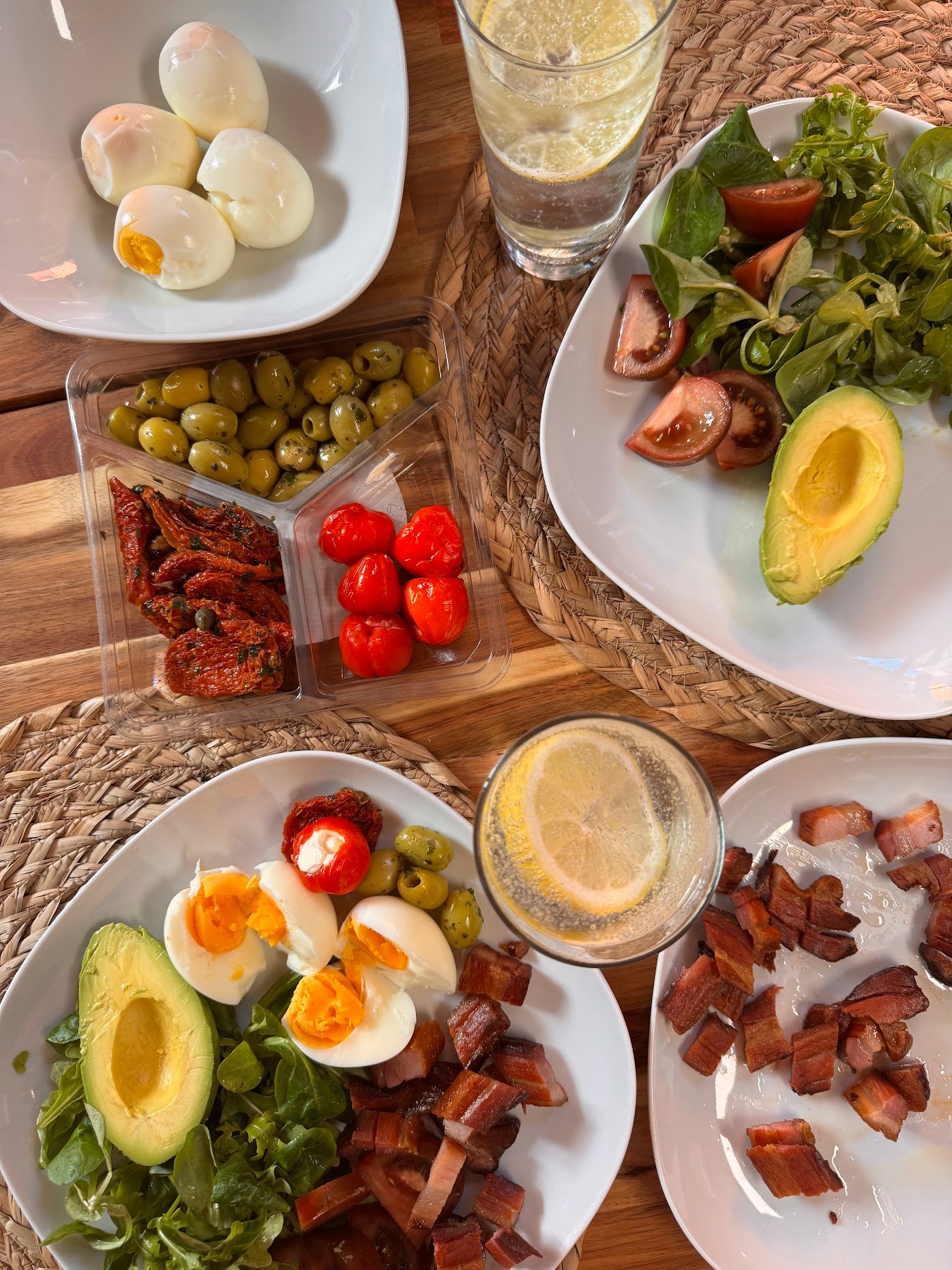
Breakfast (30-35 grams): Three eggs cooked in olive oil with feta cheese and sautéed spinach. Sometimes I add smoked salmon. This Mediterranean combination gives me protein plus healthy fats that keep me satisfied for hours.
Lunch (35-40 grams): Grilled fish or seafood with a large salad dressed in olive oil, topped with nuts or cheese. Yesterday it was grilled octopus with white beans (yes, I include some legumes—they’re traditional Mediterranean food). Today it’s tuna with chickpeas and vegetables.
Dinner (30-35 grams): Often a frittata loaded with vegetables and cheese, or grilled chicken thighs with roasted vegetables and tahini sauce. Sometimes it’s a seafood stew with fennel and tomatoes.
Notice what’s missing? Protein shakes. Bars. Powders. Processed “keto” products. Just real food that humans have been eating around the Mediterranean for thousands of years.
The Quality Question
Marta, who’s 52 and teaches in Barcelona, asked me if all protein is created equal. She’d started tracking and was hitting her numbers, but still felt exhausted. When we looked at her food diary, I saw the problem immediately. Most of her protein came from processed turkey slices, protein bars, and low-fat cheese.
Protein quality matters enormously in perimenopause. Your body needs complete proteins with all essential amino acids, and it needs them accompanied by nutrients that support absorption and utilization.
A study of 600 perimenopausal women found that those who got at least 60% of their protein from whole food sources had significantly better outcomes—more stable energy, better body composition, fewer hot flashes—than women relying heavily on processed protein products.
The Mediterranean diet naturally emphasizes high-quality protein sources. Wild-caught fatty fish like sardines, mackerel, and salmon. Free-range eggs from chickens that actually see sunlight. Sheep and goat cheese from animals eating their natural diet. These foods deliver protein your body recognizes and can use efficiently.
When You’re Not Hungry for That Much Food
I know what some of you are thinking. “Susana, I can barely finish what I’m eating now. How am I supposed to eat more?”
This is where many women get stuck. Perimenopause can suppress appetite in some women, especially those dealing with stress, poor sleep, or blood sugar instability. But your body still needs the nutrition even when hunger signals are confused.
Several strategies have helped both me and the women in my community:
Start with breakfast protein. Getting 30 grams first thing sets up your entire day differently. Your blood sugar stabilizes, your energy improves, and ironically, your appetite often regulates better throughout the day.
Choose calorie-dense proteins. Fatty fish, whole eggs with yolks, full-fat cheese, and nuts give you more protein per volume. You don’t have to eat huge portions. Six ounces of salmon provides about 40 grams of protein—that’s a meal-sized piece but not enormous.
Prioritize protein first at meals. Eat the fish or eggs first, then add vegetables and other foods. This ensures you get the protein even if you don’t finish everything.
Eva, one of my clients, discovered that she’d been filling up on vegetables and then having no room for adequate protein. When she flipped her eating order—protein first, then vegetables—she easily hit her targets without feeling stuffed.
The Metabolic Benefits Beyond Muscle
Here’s something that surprised me when I increased my protein intake: my perimenopause symptoms improved across the board, not just my muscle tone.
Research explains why. Adequate protein in perimenopause supports stable blood sugar, which reduces hot flashes and night sweats. It provides the amino acids your body needs to produce neurotransmitters, which helps with mood, sleep, and brain fog. It supports your metabolism at a time when it naturally wants to slow down.
A 2023 study found that perimenopausal women consuming adequate protein (above 1.2g/kg body weight) had 40% fewer severe hot flashes than women eating less protein. The researchers theorized that better blood sugar control and reduced inflammation were the mechanisms.
I notice this in my own body. When I slack on protein for a few days—it happens, life gets busy—my night sweats return. My sleep gets choppy. My mood dips. My afternoon energy crashes hard. When I’m consistent with 100+ grams daily, I sleep better, feel more stable emotionally, and have energy that carries me through the day.
The Mediterranean Proteins That Deliver
Let me give you the practical list of what actually works in my kitchen and the kitchens of women throughout my community:
Fatty fish and seafood: Sardines, mackerel, salmon, anchovies, octopus, squid, mussels, clams. These are protein powerhouses that also deliver omega-3s and minerals. A can of sardines has about 23 grams of protein and costs less than two euros.
Eggs: The most perfect protein food. Three large eggs give you about 18 grams of protein plus choline for brain health and B vitamins for energy. I go through at least two dozen eggs weekly.
Quality cheese: Feta, manchego, aged pecorino, halloumi. Real cheese from grass-fed animals provides protein plus calcium and vitamin K2 for bone health. An ounce of feta has about 6 grams of protein.
Greek yogurt: Full-fat, plain. About 15-20 grams of protein per cup, plus probiotics that support gut health during hormonal shifts.
Poultry and meat: Chicken thighs (more flavorful and nutritious than breasts), lamb, occasionally beef. I choose fattier cuts because they’re more satisfying and nutrient-dense.
Nuts and seeds: Almonds, walnuts, pine nuts, pumpkin seeds, tahini. These are supporting players rather than main protein sources, but they add up. A quarter cup of almonds gives you about 7 grams of protein.
Legumes: White beans, chickpeas, lentils. Yes, they contain carbs, but they’re traditional Mediterranean foods that provide protein, fiber, and resistant starch. I include them in moderation, especially white beans with fish—a classic combination.
What Changed When I Got This Right
I need to tell you something I’ve never admitted publicly. When I first lost weight seven years ago, I was eating about 70 grams of protein daily and thought that was plenty. I maintained my weight loss, felt good, and believed I’d found my formula.
Then perimenopause hit like a freight train at 43. Suddenly the same eating pattern that had worked beautifully started failing. I was gaining weight around my middle despite no changes in my diet. My arms and legs looked thinner while my waist expanded. I felt weak. My hair was thinning. I was cold constantly.
Increasing my protein to 100-110 grams daily changed everything within about six weeks. My muscle tone returned. My energy stabilized. My hair stopped falling out in alarming quantities. My body temperature regulated better. The weight around my middle gradually reduced as I built back the muscle I’d been losing.
This wasn’t magic. It was giving my perimenopausal body the specific nutrition it needed to function optimally during hormonal upheaval.
Your Body Is Not Broken
The message I want you to take from this is not “you’re doing everything wrong.” It’s that your body’s needs have changed, and that’s completely normal. You’re not failing at something. The old rules simply don’t apply to your current hormonal reality.
Understanding how much protein perimenopause actually requires was the missing piece for me and for hundreds of women in my community. Not because protein is a magic solution, but because it’s a fundamental requirement your body cannot negotiate away, especially when hormones are shifting.
You don’t need expensive supplements or complicated protocols. You need real, nourishing Mediterranean foods in adequate amounts. You need to give yourself permission to eat substantially. You need to stop shrinking your portions and start feeding your changing body what it actually needs.
Calculate your protein target today. Track honestly for a few days to see where you actually are. Then start closing that gap with real food—fatty fish, eggs, good cheese, nuts, legumes. Give it six weeks of consistency and notice what changes.
Your body is not the enemy. It’s trying desperately to maintain your health through a massive transition. Feed it well, and it will surprise you with its resilience.